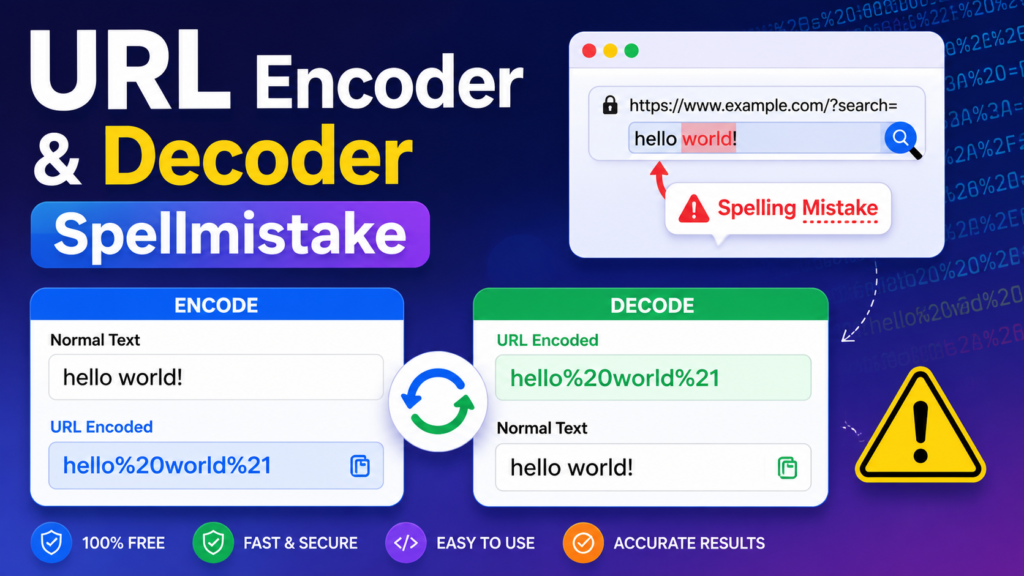
URL Encoder and Decoder Spellmistake
If you have searched for the url encoder and decoder spellmistake, you are probably trying to understand whether the phrase itself is incorrect or looking for information about mistakes that occur while encoding and decoding URLs. The term can refer to both a spelling error in search queries and common errors made when working with URL encoding tools. Understanding how URL encoding and decoding works is essential for developers, digital marketers, website owners, and anyone who shares web links online.
URL encoding ensures that special characters, spaces, and symbols are safely transmitted over the internet. URL decoding reverses that process so the original text can be read correctly. Even a small mistake can break a web address, cause application errors, or prevent data from being processed as intended.
What Does URL Encoder and Decoder Spellmistake Mean?
The phrase url encoder and decoder spellmistake usually appears when someone accidentally misspells “spell mistake,” “encoder,” or “decoder” while searching online. In other situations, it refers to errors made during the encoding or decoding process that produce incorrect URLs or unreadable text.
Many users search this keyword because they encounter unexpected characters such as %20, %2F, %3A, or %26 and want to understand whether the encoding process is working correctly.
What Is URL Encoding?
URL encoding is the process of converting special characters into a format that web browsers and servers can safely interpret. Characters that are not allowed directly in a URL are replaced with a percent sign followed by hexadecimal values.
For example, a space becomes %20, while many reserved symbols are converted into encoded equivalents. This ensures that the browser sends the correct information without confusion or data loss.
Without proper encoding, URLs containing spaces, symbols, or non-English characters may fail to work correctly.
What Is URL Decoding?
URL decoding performs the opposite task. It converts encoded characters back into their original readable form.
For instance, %20 becomes a normal space, making encoded data easier for humans and applications to understand. Decoding is commonly used when processing search queries, form submissions, and application parameters.
Proper decoding ensures that the information originally entered by the user is accurately restored.
Why Do URL Encoding Mistakes Happen?
The url encoder and decoder spellmistake often results from misunderstandings about how encoding works. Some users manually edit encoded URLs without realizing that reserved characters have specific meanings.
Others accidentally encode a URL multiple times, producing values that applications cannot interpret correctly. In many cases, developers forget to decode incoming data before displaying it, leading to confusing strings of encoded characters.
Simple spelling mistakes while searching for encoding tools also contribute to the popularity of this keyword.
Common URL Encoding Errors
One frequent mistake is leaving spaces unencoded. Since URLs cannot contain ordinary spaces, they must be converted into an acceptable encoded value.
Another common issue occurs when reserved symbols are used directly instead of being encoded. Characters such as question marks, ampersands, and hash symbols have special purposes inside URLs. Incorrect handling can change the structure of the address and produce unexpected results.
Double encoding is another widespread problem. When already encoded data is encoded again, the resulting URL becomes invalid or difficult to decode correctly.
Common URL Decoding Errors
Improper decoding can create problems just as serious as incorrect encoding.
Some applications attempt to decode data that was never encoded, producing unexpected output. Others decode the same value repeatedly, changing characters that should remain unchanged.
Developers may also overlook character encoding standards, causing international characters to display incorrectly or become unreadable.
How to Identify Encoding Problems
Recognising an encoding problem usually starts with examining the URL carefully. Long strings containing percent signs followed by two hexadecimal characters generally indicate encoded content.
If a webpage displays %20, %3F, or %26 instead of readable characters, the decoding process may not have been completed properly.
Broken links, missing parameters, failed redirects, and invalid form submissions are also common signs that URL encoding or decoding has been handled incorrectly.
Best Practices for URL Encoding and Decoding
The best approach is to let programming languages and trusted encoding libraries perform the work automatically instead of editing URLs manually.
Always encode user input before placing it inside a URL. Likewise, decode incoming data only when necessary and only once.
Testing URLs with different characters, including spaces, symbols, and international text, helps ensure applications behave consistently across browsers and devices.
Following accepted web standards significantly reduces the chance of encountering the url encoder and decoder spellmistake during development.
Why Proper URL Encoding Matters for SEO
Correct URL encoding contributes to a better user experience and improved search engine accessibility.
Search engines prefer URLs that are consistent, readable, and technically accurate. Improper encoding may create duplicate URLs, indexing issues, or broken pages that negatively affect website performance.
Clean URL structures also make links easier to share across social media platforms, email campaigns, and messaging applications.
URL Encoding in Modern Web Applications
Modern websites rely heavily on URL encoding for search functions, online forms, APIs, payment gateways, login systems, and multilingual websites.
Every time users submit information containing spaces or special symbols, encoding helps preserve the original data while maintaining compatibility with web standards.
Decoding then reconstructs the original information when the application needs to display or process it.
Can Spelling Mistakes Affect Search Results?
Yes. Searching for url encoder and decoder spellmistake instead of a correctly spelled phrase may still produce useful results because modern search engines automatically recognise similar spellings.
However, using accurate terminology often returns more relevant documentation, tutorials, and technical explanations. Correct spelling also improves communication when discussing encoding issues with developers or technical support.
Conclusion
Understanding the url encoder and decoder spellmistake is valuable whether you are dealing with a simple spelling error or troubleshooting URL encoding problems. Proper URL encoding protects web addresses, preserves data accuracy, and ensures reliable communication between browsers and servers. By using trusted encoding methods, avoiding manual modifications, and following established web standards, you can prevent common mistakes and maintain functional, search-friendly URLs.