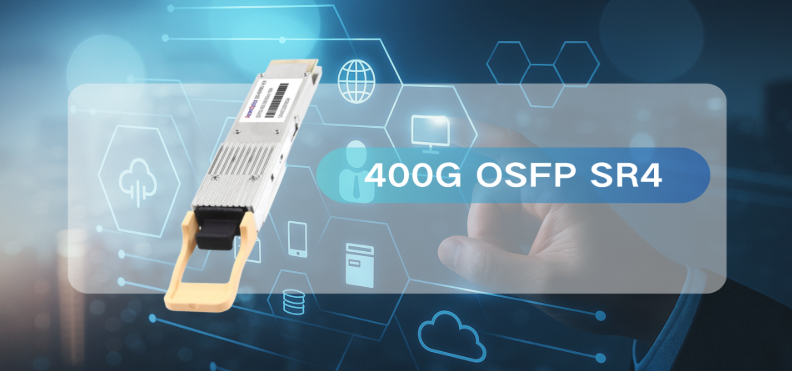
The rapid expansion of artificial intelligence (AI), machine learning, and high-performance computing is transforming the way modern data centers are designed. AI workloads require massive amounts of data exchange between GPUs, servers, and network switches, making high-speed and reliable connectivity a critical factor in overall system performance. As AI clusters continue to scale, data center operators need optical solutions that can provide higher bandwidth while maintaining low latency, efficient power consumption, and cost-effective deployment.
Among the various 400G Ethernet solutions available today, 400G QSFP112 modules have become an important choice for next-generation AI data center networks. These modules provide high-density 400Gbps connectivity while using the compact QSFP112 form factor, making them suitable for modern high-speed switches and server networking environments. Within this category, 400GBASE-SR4 optical modules are designed specifically for short-distance, high-bandwidth connections inside data centers.
The adoption of 400GBASE-SR4 optical modules reflects the increasing demand for efficient short-reach interconnect solutions in AI infrastructure. While technologies such as 800G and 1.6T optical modules are emerging for future networks, 400G SR4 continues to play a critical role in current AI deployments because of its mature ecosystem, lower deployment cost, and ability to support high-density connections between servers and switches.
What Is a 400GBASE-SR4 Optical Module?
A 400GBASE-SR4 optical module is a high-speed Ethernet transceiver designed to support 400Gbps data transmission over multimode fiber (MMF). It follows the 400GBASE-SR4 standard and is optimized for short-distance applications within data centers, typically supporting transmission distances of up to 50 meters when using OM4 multimode fiber.
The “SR4” designation represents the characteristics of this optical technology. “SR” stands for Short Reach, indicating that the module is designed for short-distance communication, while the number “4” refers to the four parallel optical lanes used for transmission. By using four optical channels, each operating at 100Gbps, the module achieves an aggregate bandwidth of 400Gbps.
Unlike longer-distance 400G optical solutions such as 400GBASE-FR4 or 400GBASE-DR4, SR4 is optimized for cost-efficient and high-density connections. It is commonly deployed in environments where switches, servers, and computing resources are located within close proximity.
Technology Behind 400GBASE-SR4 Optical Modules
PAM4 Modulation Enables High-Speed Transmission
One of the key technologies that allows 400GBASE-SR4 modules to achieve high bandwidth is PAM4 (Pulse Amplitude Modulation 4-level). Traditional NRZ signaling transmits one bit per symbol, while PAM4 uses four signal levels to transmit two bits per symbol. This doubles the data capacity without requiring a significant increase in signal frequency.
For 400GBASE-SR4 modules, PAM4 technology enables each optical lane to achieve 100Gbps transmission rates. Combined across four lanes, the module can deliver a total bandwidth of 400Gbps. However, higher-speed modulation also introduces additional signal complexity, requiring advanced electrical design and signal processing technologies to maintain reliable transmission performance.
850nm VCSEL and Multimode Fiber Technology
400GBASE-SR4 optical modules typically operate at an 850nm wavelength using VCSEL (Vertical Cavity Surface Emitting Laser) technology. VCSEL-based optical solutions have been widely adopted in short-distance data center applications because they provide efficient optical transmission, lower manufacturing costs, and reliable performance.
The use of multimode fiber makes SR4 modules particularly suitable for high-density data center environments. Compared with single-mode fiber solutions, multimode fiber infrastructure is generally more economical for short-reach connections, making it a practical choice for connecting equipment within racks or across adjacent racks.
MPO-12/APC Parallel Fiber Interface
To support four optical transmission lanes, 400GBASE-SR4 modules typically use MPO-12/APC connectors. The parallel fiber interface allows multiple optical channels to be transmitted simultaneously through a single compact connector, helping reduce cable complexity in high-density networking environments.
The MPO-12/APC interface is widely used in modern data centers because it provides efficient fiber management and supports high-speed parallel optical transmission. This makes 400G SR4 modules easier to integrate into existing structured cabling systems.
Why 400GBASE-SR4 Is Important for AI Data Center Networks
Supporting High-Density GPU Connectivity
AI training and inference workloads rely on fast communication between GPUs, servers, and network switches. In large AI clusters, thousands of computing devices must exchange data continuously, and network delays can reduce overall system efficiency.
400GBASE-SR4 optical modules provide the bandwidth required for many AI networking applications, especially connections between servers and top-of-rack (ToR) switches. Their compact QSFP112 form factor allows data centers to achieve higher port density while maintaining efficient rack layouts.
Balancing Performance and Deployment Cost
Although higher-speed optical technologies are becoming available, not every network connection requires 800G or 1.6T bandwidth. Many AI and cloud environments still require cost-effective 400G solutions that provide sufficient performance for current workloads.
400GBASE-SR4 offers an effective balance between bandwidth, power consumption, and deployment cost. By using multimode fiber and short-reach architecture, organizations can build high-performance networks without significantly increasing infrastructure expenses.
Enabling Scalable Data Center Architectures
Modern AI data centers require scalable network architectures that can grow alongside increasing computational demand. 400G SR4 modules help create flexible Ethernet fabrics by providing high-speed connections between switches and computing resources.
As data centers continue to expand, these optical modules provide a reliable foundation for short-distance connectivity while allowing operators to gradually transition toward future higher-speed technologies.
Applications of 400GBASE-SR4 Optical Modules
400GBASE-SR4 optical modules are widely used in AI clusters, cloud data centers, and high-performance computing environments. Their primary application is short-distance Ethernet connectivity between switches, servers, and storage systems where high bandwidth and low latency are required.
In AI infrastructure, SR4 modules are commonly deployed for rack-level and row-level connections, where large numbers of GPUs and networking devices need efficient communication. In enterprise and cloud environments, they provide a practical upgrade path from 100G and 200G networks to higher-speed 400G Ethernet architectures.
Conclusion: 400GBASE-SR4 Remains a Key Solution for AI Networking
As AI workloads continue to grow, data centers require optical connectivity solutions that can deliver higher bandwidth, greater density, and improved efficiency. 400GBASE-SR4 optical modules provide an ideal solution for short-distance AI data center networking by combining 400Gbps performance, PAM4 technology, multimode fiber connectivity, and compact QSFP112 design.
While future networks will continue moving toward 800G and 1.6T technologies, 400GBASE-SR4 will remain an essential component of modern AI infrastructure. Its balance of performance, cost efficiency, and deployment flexibility makes it a critical optical solution for building scalable and high-speed data center networks.