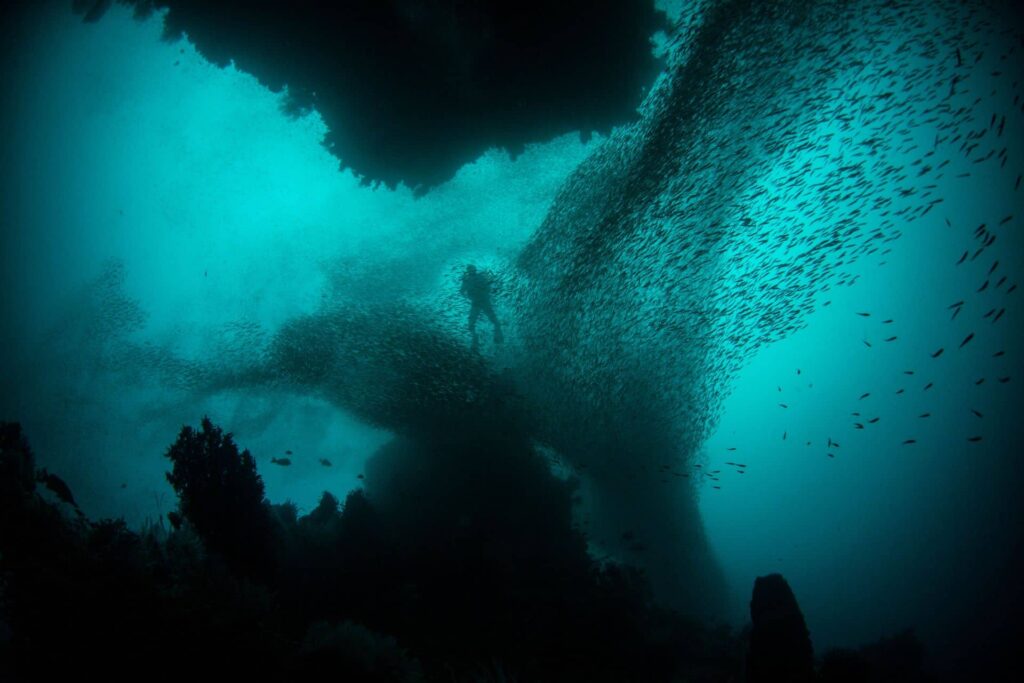
We often say we have mapped the world. We carry the whole planet in our pockets, zoom in on a rooftop halfway across the globe, and trace a route through streets we have never walked. It is easy to feel that there is nothing left to discover. And yet, most of our own planet remains genuinely unknown. It sits beneath the surface of the ocean, in cold and crushing darkness, and we have seen only a sliver of it.
More of the Ocean Floor Is Unmapped Than Mapped
The ocean covers a little over seventy percent of the Earth, and most of it runs deep. F
or all our satellites and sensors, we have only directly mapped a small fraction of the seafloor in fine detail. We have far better maps of the surface of the Moon and Mars than we do of the bottom of our own oceans.
The reason is simple physics. Light does not reach the deep sea, and the radio signals that map dry land from orbit cannot see through water. To chart the seafloor properly you have to send sound down through the water and listen for the echo, one strip at a time, from a ship moving slowly across an enormous space. It is patient, expensive work, and the ocean is very large.
A World Built for Crushing Pressure and Total Dark
Below a few hundred meters the sunlight gives out completely, and the temperature drops close to freezing. Deeper still, the weight of the water above becomes staggering. At the greatest depths the pressure is hundreds of times what we feel at the surface, enough to crumple ordinary equipment like a can underfoot.
For a long time people assumed nothing could live down there. It seemed obvious that life needed sunlight, warmth, and reasonable pressure. That assumption turned out to be badly wrong. Life is not just surviving in the deep. In places it is thriving in forms strange enough to rewrite what we thought living things could be.
Life That Does Not Need the Sun
One of the great surprises of ocean science was the discovery of hydrothermal vents, cracks in the seafloor where superheated, mineral rich water pours out from inside the Earth. Around these vents, whole communities live in permanent darkness, far beyond the reach of any sunlight.
What makes this remarkable is the foundation the ecosystem is built on. On land and in shallow water, almost everything ultimately runs on sunlight through the plants that capture it. Around the vents, tiny organisms instead draw their energy from the chemicals in the venting water. Everything else feeds on them or on each other. It is an entire living world powered by the planet itself rather than by the Sun, and it hints that life might take hold in far stranger places than we once imagined, including beneath the ice of distant moons.
Creatures That Look Like Inventions
The animals of the deep are shaped by a world of scarcity and darkness, and it shows. Many make their own light, using it to lure prey, find mates, or confuse a predator. Some are nearly transparent. Others are soft and slow, built to spend as little energy as possible in a place where meals are rare and far apart.
New species turn up almost every time researchers take a serious look. A single expedition can return with animals no one has ever described. This is not because the deep sea is empty, but because it is so vast and so hard to reach that most of what lives there has simply never met us.
Why the Unknown Down There Matters Up Here
It would be easy to treat all this as a curiosity, interesting but distant. It is not. The deep ocean shapes the whole planet. It stores enormous amounts of heat and carbon, and in doing so it quietly influences the climate we all live in. Its currents move nutrients around the globe and help drive the systems that make the surface world livable.
There is a practical urgency too. People are already looking at the deep seafloor for valuable minerals, and fishing and pollution reach further down than they used to. We are in the strange position of being able to disturb a place before we have even understood it. Learning what is there, and how it works, is not only about wonder. It is about knowing what we stand to lose.
The Last Great Frontier Is Closer Than We Think
We tend to look up when we think about exploration, toward other planets and distant stars. But there is a genuine frontier much closer to home, one that is dark, immense, and full of things we have never seen. The deep ocean is a reminder that the age of discovery is not over. Most of our own world is still waiting, quietly, in the dark, for us to go and look.