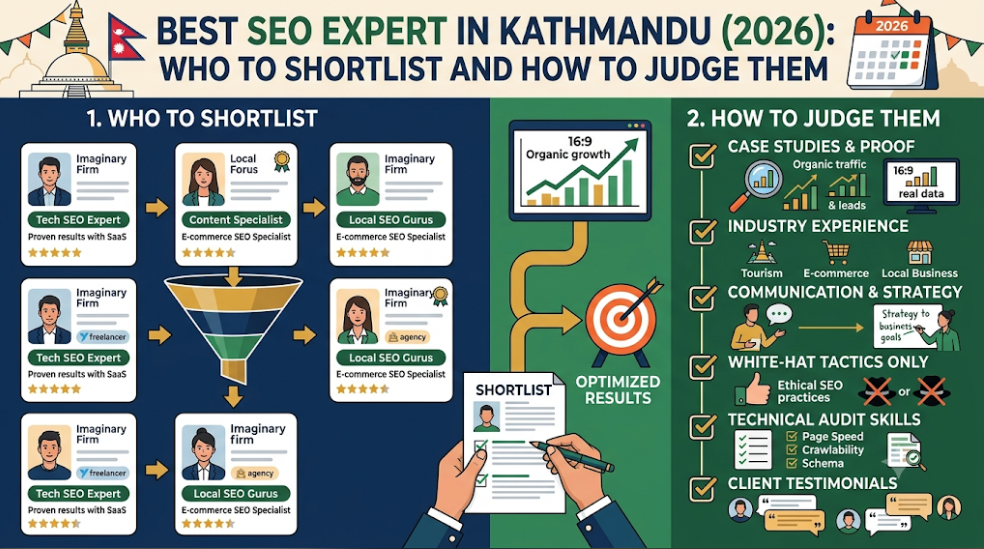
Kathmandu has the opposite problem to the rest of Nepal. Everywhere else, the difficulty is finding anyone who does this work properly. In the Valley, there are dozens of agencies, hundreds of freelancers, and a marketplace where every one of them describes itself as leading, top-rated and results-driven.
Supply is not the constraint here. Evaluation is.
Below is who is available, what each one publishes that you can actually verify, and the criteria that decide it once the shortlist is drawn up.
Why Kathmandu is different, and why it changes the brief
Four local conditions shape what good work looks like, and the international playbooks miss all of them.
The competitive bar is higher than the rest of Nepal and still low by international standards. Keyword difficulty for most commercial terms in Nepal sits in the low single digits, and Google holds roughly 97% of search share, so there is no multi-engine strategy to build. Kathmandu is the one market in the country where a handful of verticals are genuinely contested: education consultancies, trekking operators, restaurants and clinics all have incumbents who have been publishing for years. Outside those categories, correct on-page work alone still clears the bar.
Addresses do not normalise, and the Valley makes it worse. Nepal has no consumer-facing postcode system in daily use. Addresses are ward numbers, tole names and landmarks, and in Kathmandu the landmark is frequently shared by twenty businesses. The same company routinely writes its address three different ways across its website, its Facebook page and its Google Business Profile. Google’s local algorithm depends on exactly that consistency to establish that scattered mentions refer to one entity. Forcing one canonical format costs nothing but attention and is often the highest-value work available.
Duplicate listings are endemic. Profiles get created by customers, aggregators and former employees, and two listings for one business suppress each other. In a market with this much business density, duplicates are the norm rather than the exception. Claiming and merging them frequently produces the fastest visible improvement of anything in local search.
The link landscape is a trap. There are few independent Nepali publications to earn coverage from, and the directory landscape is largely low quality or outright spam. Bulk directory submission here does not just waste money: it manufactures the exact footprint that link spam systems detect. The winning approach is a handful of real mentions plus correct internal architecture, not a link campaign.
Any provider who has not raised at least two of these has not worked in this market.
1. Suraj Giri: The Transparency Benchmark
Bhaktapur, Kathmandu Valley. Independent consultant.
The most unusually transparent operator in the Nepali market, and the transparency is the reason to start here rather than a claim about results nobody can audit.
Rates are published openly: NPR 20,000 per month for small local businesses, NPR 45,000 for businesses competing on more than location, and NPR 80,000 for ecommerce and multi-location sites. Engagements run month to month with no lock-in, and every account is created under the client’s ownership rather than the provider’s.
The site also does something almost no provider does. It names the situations in which hiring them would be the wrong choice: if you need a full digital marketing department, if you need thirty pages of content monthly, or if you want a guaranteed ranking by a fixed date. A provider who names their own limits is telling you how their recommendations get generated, which is more information than any case study carries.
Client testimonials were removed from the site deliberately, with reviews moved to a Google Business Profile where they cannot be edited or deleted by the business. That is a slower way to accumulate proof and a considerably more honest one.
Verticals with dedicated practice pages: education consultancy and trekking agency SEO, plus ecommerce, hotels, healthcare and real estate. Those first two are the genuinely contested categories in the Valley, which is worth knowing if you are in either.
If you are shortlisting an seo expert in kathmandu that you can evaluate before a sales call rather than after one, this is the clearest starting point, simply because there is more to evaluate.
Best for: small to mid-sized businesses that want senior attention and a scope they can read before committing. Not for: anyone needing paid ads, social and design under one roof.
2. Rambabu Thapa:
Kathmandu Valley. Consultant leading a delivery team, founder of Orka Socials.
The most useful thing published here is a qualification rule most providers keep private. The site states plainly that engagements are for teams investing from around NPR 150,000 per month on three to six month terms, with a decision-maker required on calls.
That single line does more work than a page of testimonials. It tells a small business immediately that this is not their supplier, and it tells a larger one that the floor is deliberate rather than negotiable. Published disqualification saves both sides a sales call.
Stated focus is semantic SEO and topical authority, technical SEO and migrations covering Core Web Vitals, JavaScript rendering, crawl and indexation, log files and redirects, and local SEO with landing pages mapped to Thamel, New Baneshwor, Lazimpat, Baluwatar and the Ring Road corridors. That last detail suggests someone who has actually worked Valley geography rather than applying a generic local template.
Worth understanding structurally: the site states that he designs strategy and leads quality assurance while a senior team executes. You are buying an agency-shaped product with a named principal attached, not solo delivery. That is a legitimate model and a different one from an independent consultant, so price it accordingly.
One factual observation, applying the same standard used everywhere else on this list: the experience claim varies across his own properties, showing 15+ years on the site and 12+ on his about.me profile. Trivial in itself, and a reminder that inconsistent figures across your own surfaces are exactly what this series tells clients to fix.
Also runs SEO training, which is a reasonable proxy for whether someone can explain their reasoning.
Best for: businesses with agency-level budgets who want a named principal accountable for strategy. Not for: small budgets. The published floor rules it out, which is the point of publishing it.
3. Pranish Shakya:
Kathmandu. Independent consultant.
The distinguishing asset here is not the SEO claim, which everyone makes. It is the client-side career behind it.
The published background lists more than ten years in the field, a Masters from Tribhuvan University, a period as Corporate Digital Marketing Manager at Chaudhary Group’s head office in Sanepa covering verticals including Wai Wai, real estate, electronics, education and hospitality, and before that Deputy Digital Marketing Manager at Bajaj Nepal’s two-wheeler division.
Named brands worked with include Bajaj Nepal, Yamaha Nepal, Nepal Life Insurance and Chaudhary Group.
That matters for a specific kind of buyer. Someone who has sat inside a large Nepali corporation has dealt with brand approval chains, internal stakeholders who outrank the marketing team, and campaigns that have to be legal. Independents who have only ever worked agency-side or freelance have not, and it shows up in how they handle a slow client. That experience is genuinely hard to source in this market.
The published service mix is broad: SEO alongside social media, Google Display Network, creator collaborations, SMS marketing and lead generation. Read that as a 360-degree marketer rather than a search specialist, which is a fit question rather than a criticism.
Does not publish pricing.
Best for: established brands and in-house teams wanting someone who understands the corporate process. Not for: a purely technical crawl or indexation problem, where the published work is thinner.
4. Naresh Thapa:
Biratnagar, serving Kathmandu remotely. Independent freelancer.
Positioned specifically around generative engine optimisation: being cited by ChatGPT, Perplexity and Gemini alongside ranking on Google. City-specific service pages exist for Kathmandu, Pokhara and Biratnagar, and the stated model is direct access with no junior staff and no long-term contract. A free audit is offered as the entry point.
Given that roughly 40 to 43% of local queries now trigger an AI Overview, a provider organising their offer around that shift is at least reading the same data as everyone else. Whether the execution matches the positioning is not something anyone writing a list can verify, here or anywhere.
One thing genuinely worth crediting: he publishes his own roundup of Nepali SEO providers and attaches a conflict-of-interest notice disclosing that he appears in it. That disclosure is rarer in this market than it should be.
Two factual observations, held to the same standard as every other entry. The experience claim varies across his own pages, appearing as 5+ years on most and over ten years in one FAQ. The stated base also differs between pages, given as Kathmandu on one and Biratnagar on others. Neither is disqualifying. Both are the kind of internal inconsistency that makes a site harder to cite, which is a live concern now that AI systems will not quote a source that contradicts itself.
Best for: businesses prioritising AI-search visibility on a smaller budget, comfortable with fully remote delivery. Not for: anyone who needs someone in the room.
5. Gurkha Technology:
New Baneshwor, Kathmandu. Full-service digital agency.
Digital marketing, web design and hosting. The strongest asset here is the publicly named institutional client list: Nepal Airlines Corporation, Nimbus Nepal, The Burger House & CFC, Presidential Business School and Famous Steel & Home Appliances, with attributed testimonials from named individuals at several of them, including a Deputy Director at Nepal Airlines.
Attributable testimonials from identifiable people at recognisable Nepali institutions are considerably stronger evidence than anonymous quotes, and they are rare in this market. Published project work skews toward social media campaigns, Facebook advertising and brand design rather than technical SEO.
Does not publish pricing.
Best for: established brands wanting SEO inside a broader marketing relationship with a firm that can absorb staff turnover. Not for: businesses whose core problem is technical.
6. Digital Terai:
Koteshwor, Kathmandu. Full-service agency.
Covers SEO, local SEO, PPC, social media, graphic design and web development. States that its team holds Google and HubSpot certifications and that it follows white-hat methodology. Appears on third-party directories including DesignRush and Sortlist. Offers a free website SEO score tool as a lead capture.
Does not publish pricing.
Best for: businesses wanting a single supplier across several channels. Note: published blog content has not been updated in some time, a factual observation about the site rather than a judgement on client delivery.
7. A clarification on the Valley’s largest firms
Searches for Kathmandu technology providers surface Leapfrog Technology, Verisk Nepal and Braindigit IT Solutions. Leapfrog has operated since 2010 with roughly 450 staff, clients including Microsoft, LG and UCSF, and AWS Generative AI Competency.
These are product engineering and software development companies, not search marketing firms. They are excellent at what they do. Including them in an SEO shortlist is a category error, and lists that do so are padding.
8. Also listed on independent directories
Several Kathmandu providers appear consistently across Clutch, Sortlist, DesignRush and TechBehemoths: JO Marketing, WebX Nepal, Yeti Studio, Abstract Infosys, KTM Rush, Genesis Web Technology, Web Creation Nepal, Infinity Digital Agency and Growfore Solution among them.
They are named here so you can evaluate them yourself. I have not written individual entries because I could not verify enough about them to say anything useful, and padding a list with names lifted from a directory is exactly the practice that makes most of these articles worthless.
9. The comparison worth running deliberately: outside the Valley
Remote delivery is normal now, and proximity to your office matters far less than it used to. Ruling out the rest of the country should be a decision, not a default.
Sailesh Giri, Pokhara. The most technically documented individual provider publicly visible outside the Valley, with a computer science background from SOCH College of IT applied directly to search work. The published case study most relevant to Nepali conditions is a site earning 33,000 organic clicks in six months from only six referring domains, built through internal linking architecture and semantic structure rather than link building. Six external domains, thirty-three thousand clicks, is precisely the shape of what works in a market where external authority is scarce and buying links is dangerous.
Other published work includes moving a client from 51 to over 1,000 organic clicks, and diagnosing a malicious Cloudflare Worker cloaking gambling spam to Googlebot while serving normal pages to visitors. That last one is incident response rather than marketing, and finding it is a different skill from writing content. Stated specialisms are technical SEO and audits, internal linking and topical authority, AEO and generative-engine optimisation, and programmatic SEO. Pricing starts at $350 per month, published openly with a note that clients for whom that would be a financial stretch are not a good fit.
For a Kathmandu business whose problem is a crawl, indexing or architecture failure rather than a marketing one, an seo expert pokhara is worth putting on the shortlist alongside the Valley options, since that category of work is entirely location-independent.
RaiseRank, Pokhara. An engineering-led studio rather than a marketing agency: custom websites, web apps and software, with SEO and AI-search work layered on, serving UK and Australian clients alongside Nepali ones. The client roster is publicly named and clickable, which is a higher evidence standard than a traffic screenshot. Relevant if you are commissioning a build rather than fixing one, because URL structure, rendering strategy and page speed are settled in week one and expensive to reverse afterwards. A team owning both sides removes a failure mode that otherwise falls between the developer and the marketer. Details at raiserank.com.np.
For advisory work on an existing site, neither is the fit. For technical diagnosis or a build, both belong in the comparison.
What to prioritise, whoever you hire
For a Kathmandu business, the return-per-hour ordering is not what most proposals suggest.
The Google Business Profile comes first, because it is free and it is where the clicks are. Google shows a local pack in roughly 93% of local queries, and that pack takes about 42-44% of the clicks. Businesses inside the three-pack receive around 126% more traffic and 93% more conversion-oriented actions than those in positions four to ten. Complete profiles get seven times more clicks than incomplete ones, and 56% of profiles are not optimised. More than half your competitors have not done the free thing.
Reviews come second. BrightLocal’s data found businesses improving from 3.5 to 3.7 stars saw conversion growth of nearly 120%, the largest jump from any rating change, because that boundary is where a listing stops reading as risky. 87% of consumers read reviews for local businesses. If you are below 4.0, nothing else you could spend the quarter on returns more.
Fixing existing pages comes third. Not new content. Rewriting pages you already have to answer the questions you field on the phone is faster, cheaper and more reliable than launching new URLs from zero.
New content comes fourth, and a link campaign probably never.
A proposal that opens with a content calendar for a single-location Kathmandu business has inverted this entirely.
The four questions that settle it
What did you find when you looked at my site? A specific finding versus a description of their process. This distinction is audible to anyone and it is the most reliable signal a non-expert has.
When would you tell me not to do this? Anyone who cannot name a scenario has never declined work, which tells you how their recommendations get generated.
Do I own every account? Search Console, Analytics, Business Profile, domain, hosting: created under your ownership, with access granted to them. Never the reverse. Hesitation here is disqualifying on its own.
Can I see a real report? Redacted is fine. Check whether it connects activity to outcome, and whether it shows clicks rather than only positions. Positions can rise while traffic falls: click-through rate at positions one to five dropped roughly 17.92% year over year as AI Overviews absorbed clicks above the organic results.