Table of Contents
- Why Play-Based Learning Works
- Build Early Math Skills Through Play
- Support Language and Early Literacy
- Practice Social and Emotional Skills
- Add Movement and Motor Practice
- Use a Simple Activity Plan
- Know When to Guide and When to Step Back
- Make Activities More Inclusive
- Common Questions
- Final Thoughts
Preschoolers learn best when they can touch, move, imagine, talk, and try again. Play-based learning turns ordinary moments into meaningful practice for early math, language, self-control, and friendship skills. A basket of blocks, a pretend restaurant, or a simple matching game can become a learning opportunity without making the experience feel like a lesson.
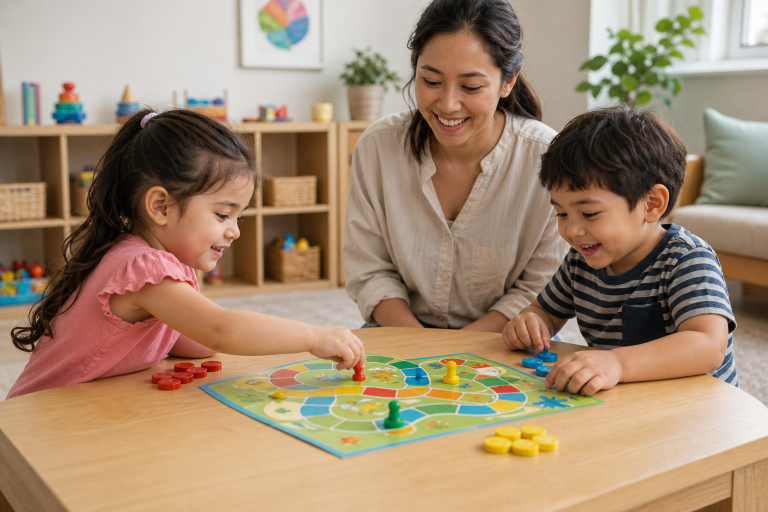
Parents, caregivers, and teachers do not need complicated supplies to get started. Purposeful toys, including learning board games for ages 3 to 4, can give children a fun reason to count, follow directions, wait for a turn, and solve small problems together. The most effective activities leave room for the child’s ideas.
Why Play-Based Learning Works
Play-based learning is learning that happens through active, enjoyable experiences. Free play is child-directed, such as inventing a castle with cushions. Guided play begins with an adult’s goal or invitation, then gives children choices in how they explore. Adult-led activities are more structured, such as teaching the rules of a game before everyone plays.
All three approaches have value. A shape hunt can build vocabulary, movement skills, observation, and early geometry skills at once. A pretend grocery store can involve counting, conversation, cooperation, and imagination. Short activities often work especially well for preschoolers because children can stay engaged, move on when needed, and return later with fresh interest. The Head Start guidance on learning through play offers useful examples of how guided play can support development while keeping children actively involved.
Build Early Math Skills Through Play
Preschool math is much more than reciting numbers or completing a worksheet. Children develop number sense when they compare groups, notice patterns, sort objects, and use words such as more, less, heavy, small, beside, and next.
Easy Math Activities
- Counting collections: Count toy animals, blocks, socks, crackers, or buttons.
- Shape hunt: Look for circles, squares, triangles, and rectangles in rooms, books, or outdoors.
- Pattern making: Create red-blue-red-blue patterns with objects, claps, or jumps.
- Sorting games: Group items by color, size, texture, or purpose.
- Board and card games: Count spaces, match pictures, and remember whose turn comes next.
Instead of supplying answers, ask, “Which group has more?” “How many are left?” or “What do you think comes next?” These prompts encourage children to explain their thinking.
Support Language and Early Literacy
Play gives children natural reasons to listen, speak, describe, negotiate, and tell stories. During dramatic play, they may use new words because they need them to explain what the doctor, chef, builder, or shopkeeper is doing.
Offer picture cards, toy figures, or household objects and invite a child to create a story. Ask them to describe a drawing or explain how a block structure works. Try rhyming pairs with familiar words, sing repetitive songs, or read a short book and act out one scene afterward. In a pretend café, children can make menus, signs, orders, and labels, even if their writing is made of lines and letter-like marks.
Practice Social and Emotional Skills
Games and pretend play offer low-stakes practice with big feelings. Children learn to wait, share materials, follow a group rule, ask for help, and recover from a disappointment. Those skills grow through repetition, not through perfection.
For example, two children may both want the same long block for a bridge. Rather than immediately deciding who gets it, name the problem: “You both need this piece.” Then ask, “What are two fair ideas?” They may take turns, find a substitute, or build one bridge together. The adult keeps the interaction safe and respectful while allowing the children to participate in the solution.
Add Movement and Motor Practice
Active play supports balance, coordination, body awareness, hand strength, and visual tracking. Create an indoor obstacle path with painter’s tape, cushions, and a chair tunnel. Play freeze-and-move games with music, roll soft balls back and forth, or build towers and roads with blocks.
Fine motor practice can be just as playful. Use tongs or clothespins to move pom-poms, let children squeeze and roll play dough, or invite them to pick up large beads and sort them into cups. Match the challenge to the child’s current ability. The aim is confident practice, not a flawless result.
Use a Simple Activity Plan
- Choose one skill: Focus on counting, storytelling, matching, movement, or turn-taking.
- Gather simple materials: Use household items, recycled containers, books, blocks, or art supplies.
- Give a short prompt: Explain the invitation in one or two clear sentences.
- Let the child lead: Notice their ideas and allow the activity to change direction.
- Reflect together: Ask what was funny, tricky, easy, or surprising.
Many activities need only five to fifteen minutes. When a child remains deeply interested, it is fine to continue rather than end simply because the clock says so.
Know When to Guide and When to Step Back
Adults do not need to be every minute. Prepare a safe space, offer an inviting starting point, and observe. Step in when a child is unsafe, excluded, frustrated beyond what they can manage, or unsure how to continue. Otherwise, give them room to test ideas.
Helpful Prompts
- “What do you notice?”
- “What could you try next?”
- “Can you show another way?”
- “How could both players use it?”
- “What might happen if you change the order?”
Avoid correcting every mistake. A tower that falls or a pattern that changes unexpectedly can lead to useful thinking when children get a chance to notice the result and try again.
Make Activities More Inclusive
Inclusive play does not require every child to participate in exactly the same way. Use pictures, gestures, and spoken directions together. Offer seated and standing versions of movement games, reduce noise or visual clutter when helpful, and allow extra time for responses. Larger objects may be easier to grasp, while solo, partner, and small-group options can make participation more comfortable.
Common Questions From Parents and Caregivers
Does play-based learning have learning goals?
Yes. The goal may be counting to five, using feeling words, or practicing turn-taking. The difference is that children work toward it through choice, action, conversation, and problem-solving.
Can games support school readiness?
They can support early math, memory, listening, language, fine motor skills, and social routines. Games work best alongside reading, outdoor time, art, daily conversation, and hands-on exploration.
What if a child avoids group games?
Begin with one-on-one play, parallel play, or simple-rules games. Comfort and participation can grow gradually.
Final Thoughts
Play makes learning active, social, and memorable. A sorting game can build math language, a pretend shop can support counting and conversation, and a cooperative challenge can teach patience and teamwork. The goal is not to choose between play and learning. It is to create everyday moments where they happen together.